Crete Off-Season – When to Go, Weather & Best Things to Do in Autumn, Spring, and Winter
For most, Crete is synonymous with the scorching July heat, shoulder-to-shoulder crowds at Balos or Elafonisi, and noisy resorts that never sleep. It’s the classic Greek holiday picture, but is it the only one?
The truth is, when the last charters depart and travel agencies close their books, the island removes its tourist mask to reveal a truer, calmer, and—crucially for your budget—much cheaper side. Traveling to Crete off-season is your chance for cheap flights, massive discounts on car rentals, and luxury stays for a fraction of their summer price.
In this guide, I share my personal experiences from exploring the island when the sunbeds are tucked away. You’ll find out if Crete weather in October allows for swimming, how to prepare for sightseeing in March, and which local festivals will let you feel the true spirit of Greek filoxenia. If you are wondering when is the best time to visit Crete to avoid the heat and the crowds, this guide is for you.
Why visit Crete off-season?
Your Wallet Will Thank You
Accommodation and car rental prices drop by 40-60%. What is a budget room in July becomes a luxury sea-view suite in November.
The Luxury of Silence
Instead of fighting for an inch of sand at Elafonisi, you only hear the waves. No shouting vendors, no sunbed wars. The entire beach is yours.
A Creator's Paradise
Photographers love the soft, low sun. The lack of heat makes trekking with heavy gear a joy rather than a battle for survival.
"The real Crete begins where the charter flight schedules end. It’s when the wind smells of wild sage, and every coffee in an empty harbor feels like an invitation to belong, not just visit."
Instead of scraping ice...
Winter in Crete is worlds apart from Northern Europe. While others battle frost and darkness, you’re sipping morning coffee in Chania’s Old Harbor at 16°C and full sun. It’s the ultimate escape for digital nomads craving Vitamin D.
Let's be honest
Not everything is perfect. Resorts like Malia or Hersonissos turn into ghost towns in winter. If you want wild nightlife, you’ll be disappointed. Weather can also be moody: a sudden downpour might ruin your hike one day, only for the sun to return the next.

When exactly is "off-season" in Crete?
Technically, the season ends in October and restarts in April. But what happens in between is the island's best-kept secret. Each quarter offers a completely different vibe—from blooming floral explosions to rugged mountain peace.
Spring
March - MayThe Green Awakening
To me, this is the time of "rebirth." Hills that are sun-scorched deserts in summer now explode with greenery and thousands of wild orchids. In March, temps are around 17–18°C, rising to a pleasant 24°C in May.
Why go: Perfect for trekking (Samaria Gorge usually opens in May) and visiting Knossos without rubbing shoulders with thousands of tourists.
Autumn
September - NovemberThe Golden Window
September and October are a meteorological masterpiece. The sea is still warm as soup (often 23-24°C), and the sun no longer burns but gently caresses. The crowds vanish as schools restart, leaving the beaches silent.
Why go: Combine swimming with sightseeing without breaking a sweat. November marks the olive harvest—an incredible local experience!
Winter
December - FebruaryCretan Slow Life
In winter, Crete belongs to the Cretans. Chania, Heraklion, and Rethymno buzz with students and locals. It’s the time for long road trips with no other car in sight. You can drink coffee in the sun while looking at the snow-capped White Mountains.
Why go: Absolute lowest prices and authentic interaction with residents. Great for remote work and a "digital detox."
Crete Off-Season Weather: Facts & Analysis
The most common question is: "Can I still swim in October?" or "Will I freeze in March?". Weather on Crete outside summer is a game of contrasts. While the north might be rainy, the south coast often stays warm enough for a t-shirt.
| Month | Day Temp | Water Temp | Characteristics |
|---|---|---|---|
| March | 17°C | 16°C | Green, changeable, ideal for hiking and photos. |
| May | 24°C | 19°C | First swims, plenty of sun, flowers in bloom. |
| October | 24°C | 23°C | The best compromise: warm water and mild air. |
| December | 16°C | 17°C | Mild winter, some rain, empty cities, "slow" vibe. |
Practical Analysis: Spring vs Autumn
From my observations, there is one golden rule: Spring is for the eyes, Autumn is for the body.
- Spring (March-May): The air warms up quickly, but the sea needs time. Swimming in March is for the brave. However, nature is insane—Crete is lush green, which is a shock to summer visitors.
- Autumn (September-November): My favorite time. Even if the air hits 20°C, the sea retains the summer heat. In October, water is often 23°C, making it better for swimming than June!
Pro-Tip: The south of the island (e.g., Ierapetra, Paleochora) is usually 2-3 degrees warmer than the north coast.
Calendar of Authentic Experiences
When the massive All-Inclusive hotels fade away, the island's true soul awakens. It is off-season when you will see Crete as it truly is: dancing, feasting, and smelling of woodsmoke and freshly pressed olive oil.
Chestnut Festival in Elos & Raki Season
The village of Elos in the Kissamos region becomes the capital of
flavor in autumn.
The entire area smells of roasted chestnuts, and local farmers share their
produce—from organic honeys to homemade liqueurs.
Insider's Tip: This is also the time of Kazani—the
Tsikoudia (Raki) distillation period. It’s not just alcohol production; it’s a way
of life.
Village taverns transform into small distilleries where, to the sound of the lyre,
singing, and free snacks (meze), every new liter of spirit is celebrated. If you
see smoke rising over a village, follow it—Cretan hospitality during this time
knows no bounds.
Rethymno Carnival
Forget Venice—Rethymno has its own wild, mad, and incredibly
joyful vibe! For three weeks, the city lives through parades, masquerade balls, and
street theaters. The grand final parade attracts thousands from all over Greece, but
off-season is when it feels most authentic.
It’s an incredible contrast: the historic Venetian Old Town filled with colorful
crowds,
brass bands, and upbeat music in the middle of "winter." This is the moment you’ll
see that Cretans know how to party like no one else in the world, regardless of
the temperature outside.
Orthodox Easter (Pascha)
For many, this is the most profound experience on the island. If you can be here in
spring, do it.
Easter in Crete is almost mystical. There is nothing more moving than a
midnight service in a small mountain village, where thousands of candles are lit at
midnight
and a massive bonfire burns in the main square (the symbolic burning of Judas).
This is when the island is at its most hospitable. If you find yourself in any
village on Easter Sunday, the chances of being invited to a communal table for
roasted lamb and homemade wine are nearly 100%. It is a
celebration of community you won't experience in any summer resort.
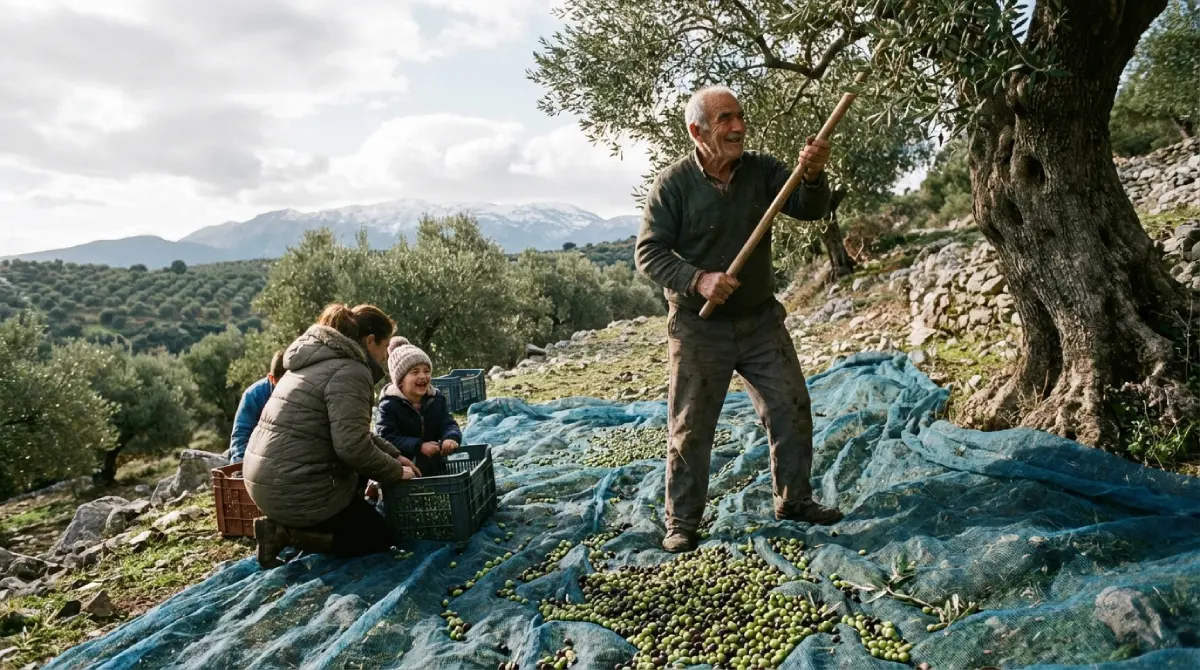
Olive Harvest Season
While not a festival in the traditional sense, this event defines
winter life in Crete more than anything else. Thousands of families head to the
groves to
harvest the "liquid gold." It is a time of hard physical labor, but also of
incredible
energy and joy.
It’s worth visiting local olive mills (elaiotriveio), which operate
around the clock. You can experience the overwhelming, intense aroma of freshly
pressed,
vibrant green oil and buy it directly from the producer—a taste that simply
cannot be compared to any store-bought oil.
Crete Off-Season: What to Do When the Island Slows Down?
Cities That Can Finally Breathe
The Venetian Port in Chania or the Old Town in Rethymno in November feels like a set for a nostalgic film. Without the tour groups and hawkers, you can hear the church bells, the sea, and the conversations of old men in the kafeneio. This is the best time to photograph architectural details that are hidden by restaurant umbrellas in the summer.
Exclusive Access to History
At Knossos, Phaistos, or Gortyna in winter, you will be almost entirely alone. You can quietly contemplate Minoan architecture without "photo-bombers" entering your frame. The lack of heat turns exploring vast ruins into a pleasant walk rather than a struggle for survival in 35-degree scorching sun.
Mountains in Vivid Green
Spring and Autumn are paradise for trekking enthusiasts. While Northern Europe is grey, orchids and herbs are blooming in Crete. Although Samaria may be closed in winter, hundreds of other trails (e.g., in the White Mountains or around the Lassithi Plateau) offer views that summer tourists never see. The air is crystal clear, and visibility stretches for dozens of miles.
Harvest Rhythms & Local Flavors
Off-season cuisine becomes more home-style. In autumn, you might stumble upon a kazani—traditional raki distilling, which is a major neighborhood party. In winter, the olive harvest begins. In taverns, instead of a "tourist menu," you’ll find seasonal delicacies: wild greens (horta), roasted chestnuts, and hearty stews that taste best by the fireplace.
How to Plan an Off-Season Trip?
Where to Stay?
Aim for year-round cities: Chania, Rethymno, or Heraklion. Resorts like Agia Marina or Hersonissos turn into "ghost towns" in winter—most hotels and shops are boarded up.
Pro-tip: Check if your room has heating (air conditioning with a heat function). Cretan nights can be damp and chilly!
How to Get Around?
Renting a car is a must. Off-season prices are incredibly low (starting from €15-20/day). KTEL buses run less frequently, and many mountain routes are inaccessible via public transport in winter.
Note: In the mountains (Lefka Ori), snow can fall in winter and early spring—check the forecast before your drive!
What to Pack?
Follow the "onion principle" (layers). You’ll be in short sleeves in the sun, but after sunset or in the shade, you’ll need a solid hoodie and a light rain jacket.
- Comfortable trekking shoes
- Sunglasses (the sun is still strong!)
- An umbrella or a hooded jacket
Opening Hours
Remember winter hours. Most museums and archaeological sites (like Knossos) from November to March close earlier—often as early as 3:00 PM or 5:00 PM.
Bonus: Many state museums offer free admission on Sundays from November to March!
Frequently Asked Questions: Crete Off-Season
Absolutely! The Libyan Sea on the southern coast stays warm at around 20-22°C until mid-November. After a scorching summer, the water retains its heat, making swimming often more pleasant than in June, when the sea is still warming up.
We highly recommend Chania, Rethymno, and Heraklion. As vibrant university cities, they pulse with life year-round. Unlike seasonal resorts like Hersonissos or Malia, most cafes, taverns, and shops here remain open to serve the local community.
Definitely. Car rental prices between November and March can be as much as 50-70% lower than during the peak summer months. An added bonus is the stress-free parking at iconic spots like Balos Lagoon or Elafonisi.
The secret is "dressing like an onion" (layering). During the day, when the sun is out, temperatures can hit 18-20°C (a light hoodie is enough). However, evenings are damp and chilly (around 8-10°C). Be sure to pack a waterproof jacket and a warm sweater for evening strolls.
Major archaeological sites, such as the Palace of Knossos, are open year-round (often with discounted tickets off-season). However, keep in mind that the Samaria Gorge is typically closed from late October until May due to rain and the risk of flash floods.
December and January are the wettest months. However, rain is usually heavy but short-lived, followed quickly by sunshine. It is this rainfall that makes Crete incredibly green and full of wildflowers by February and March.
You might also be interested in...
Handpicked specifically for you to make your journey to Crete complete.
Public Transport 2026
Discover the secrets of traveling around the island on KTEL buses. Learn how to efficiently read Greek timetables, where to buy the cheapest tickets online, and how to reach the farthest corners of Crete stress-free without needing to rent an expensive car.
Read article →Tours and Sightseeing
Plan your perfect adventure on the island. Discover whether it is better to choose professional organized tours or explore hidden gems on your own with a rental car. We analyze the best routes to Knossos, Balos, and Samaria Gorge to help you maximize your holiday time.
Read article →